
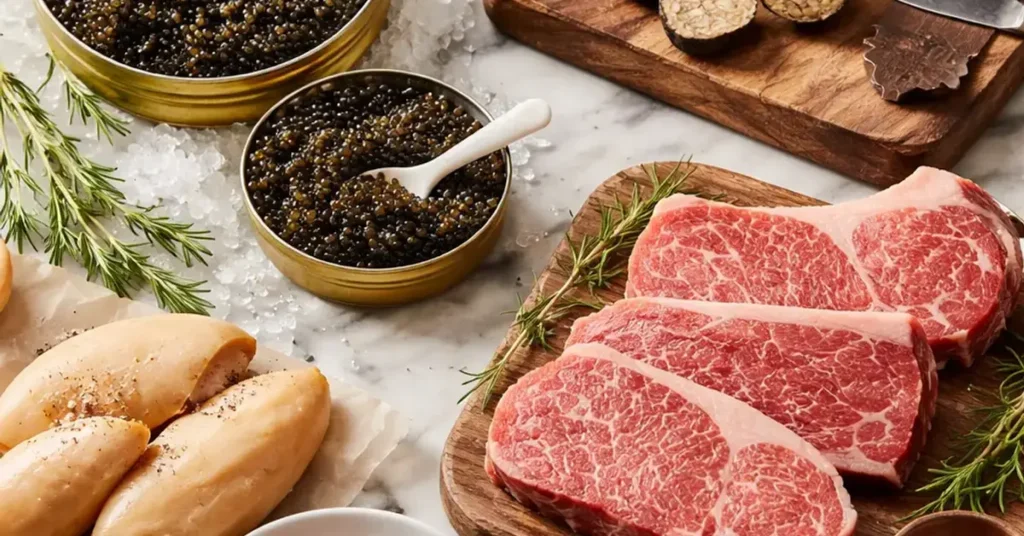
Luxury Ingredients Glossary Key Takeaways
Understanding the luxury ingredients glossary — from caviar grades to wagyu marbling scores — is essential for anyone who wants to buy, serve, or enjoy premium ingredients without overpaying or being misled.
- Caviar grades depend on species, size, color, and texture — caviar grades sourcing knowledge helps you avoid cheap imitations.
- Truffle varieties range from the prized Périgord black to summer truffles; knowing truffle grades and sourcing prevents costly mistakes.
- Wagyu beef is rated by marbling (BMS) and bloodline; a reliable wagyu beef sourcing guide ensures you get authentic Japanese or domestic Kobe-style beef.
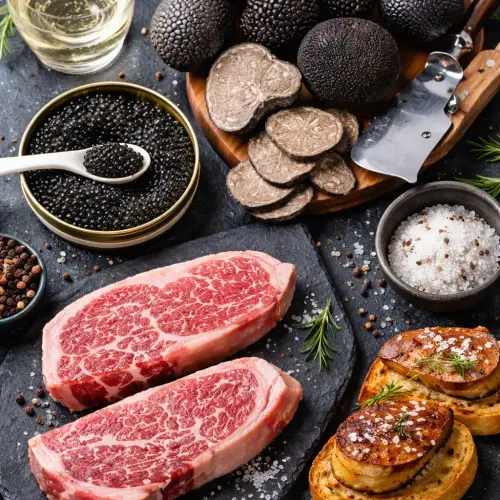
What the Luxury Ingredients Glossary Covers and Why It Matters
Fine dining and home entertaining increasingly revolve around these four pillars of indulgence. Yet each comes with its own jargon, counterfeit risks, and price traps. Without a clear luxury ingredients glossary, you might spend a fortune on “beluga” caviar that is actually paddlefish roe, or buy a steak labeled Wagyu that comes from a crossbred animal with minimal marbling. For a related guide, see Decoding Fine Dining Menus: 7 Essential Terms Explained.
This glossary arms you with the exact definitions, official grade classifications, and sourcing red flags for each ingredient. Whether you are a chef, a host, or a curious epicure, you will walk away confident in your next purchase.
Caviar Grades Sourcing: From Beluga to Sevruga
Caviar grading is a science of species, egg size, color, firmness, and salt content. Understanding caviar grades sourcing is the first step to distinguishing elite Iranian beluga from farmed American hackleback.
The Four Primary Caviar Grades
Grade 1 – Premium (Select)
Eggs are large (3 mm or larger), uniform in color, and burst cleanly on the tongue. Examples include Beluga (Huso huso) and Ossetra (Russian sturgeon). These are almost always wild-caught or from oldest, best-managed farms. Flavor is buttery, nutty, and oceanic.
Grade 2 – Standard
Slightly smaller eggs, occasional color variation, and a firmer pop. Sevruga and Siberian sturgeon often fall here. They still offer complex brininess but at a lower price point.
Grade 3 – Table Caviar
Smaller, mixed-color eggs that may be pasteurized. Often used in restaurant preparations or sauces. Loses some delicate pop but retains savory notes.
Grade 4 – Pressed Caviar (Payusnaya)
Broken eggs that are salted and pressed into a jam-like consistency. Intense flavor, ideal for spreads or finishing dishes.
Sourcing Red Flags for Caviar
- Mislabeling: True beluga is illegal to import into the US (CITES protected). Any “beluga” caviar sold legally is likely a marketing term for a hybrid or different species.
- Harvest method: Humane farms use “no-kill” techniques (milking). Ethical sourcing avoids overfished wild sturgeon.
- Salt content: Top grades use less than 4% salt (malossol). Higher salt suggests lower quality or older product.
Truffle Grades and Sourcing: Black, White, and Everything In Between
Truffles are hypogeous fungi graded by species, size, aroma intensity, and seasonality. The truffle grades and sourcing guide below helps you avoid buying summer truffle for winter truffle prices.
Grade A – True Perigord Black Truffle (Tuber melanosporum)
Harvested December–February in France, Spain, and Italy. Deep black, bumpy exterior, intense earthy aroma with notes of cocoa and forest floor. Only Grade A specimens are sold fresh to fine restaurants and retail.
Grade B – Burgundy/Summer Truffle (Tuber aestivum/uncinatum)
Lighter black-brown, less pungent. Harvested June–November. While still delicious, it cannot match the melanosporum’s depth. Many non-Italian restaurants substitute this without disclosure.
Grade C – Bianchetto/Mislabels
Small, pale, and often sold sliced in jars. Lacks the signature truffle punch. Avoid paying premium prices for these.
Sourcing Best Practices
Always buy from reputable foragers or sellers who list the Latin name and harvest region. Finedininglovers.com has a solid year-round sourcing calendar. Fresh truffles should be used within 7–10 days; store in paper, not plastic.
Wagyu Beef Sourcing Guide: Marbling, Bloodlines, and Authenticity
Wagyu beef sourcing guide is critical because the term “Wagyu” alone does not guarantee quality. True Wagyu comes from four Japanese breeds (Kuroge Washu, Akage Washu, Mukaku Washu, Nihon Tankakuchu). The Japanese Beef Marbling Score (BMS) runs from 1 (low) to 12 (extreme).
Wagyu Grades in Practice
| Grade | BMS Range | Characteristics | Typical Use |
|---|---|---|---|
| Premium (A5) | 8–12 | Butter-soft, rich umami, melts at 70°F | Sashimi, shabu-shabu, luxury steaks |
| Standard (A4) | 5–7 | Well-marbled, still tender | Grilled steaks, sukiyaki |
| Entry (A3) | 3–4 | Mild marbling, firmer | Ground meat, stir-fry, everyday cuts |
Domestic vs. Japanese Wagyu
American “Wagyu” is often Angus-cross (50% or less Wagyu blood). True Japanese Wagyu (e.g., Kobe, Matsusaka, Ohmi) is heavily regulated, with a certificate of origin. Always ask for the BMS score and the farm name. The American Wagyu Association maintains a directory of reputable breeders.
Foie Gras Grades Expectations: Whole Foie vs. Block, Ethics, and Texture
Foie gras (fatty liver of duck or goose) is graded by weight, color, and internal fat distribution. Understanding foie gras grades expectations prevents you from buying a low-grade block that disintegrates during cooking.
Grade 1 – Whole Foie Gras
Largest lobes (400–600 g for duck, 600–900 g for goose), uniform beige-pink hue, delicate membrane intact. Ideal for torching or searing whole. Expect a silky, buttery texture with a clean, sweet liver flavor.
Grade 2 – Block Foie Gras
Smaller lobes or assembled pieces. Slightly less uniform fat distribution, but still good for terrines, pâtés, or mousse.
Grade 3 – Canned/Preserved
Cooked and sterilized. Dense, crumbly texture; used in spreads or sauces. Allowed to contain up to 15% added fat or starch.
Ethical Sourcing Considerations
Traditional gavage (force-feeding) is banned in several countries. Look for producers using humane alternatives such as free-range foie gras (e.g., from Castel Rouge) or certified Artisan du Sud-Ouest products from France. These carry an Indication Géographique Protégée (IGP) label.
How to Build a Luxury Ingredients Glossary Comparison: Choice Criteria
When selecting among these ingredients, consider the following four criteria:
- Grade verification – always ask for the official grade certificate or BMS score.
- Sourcing transparency – the producer should disclose exact origin, farm, and harvest method.
- Sensory profile – each ingredient has a specific texture (pop, melt, creaminess) and aroma intensity.
- Price per unit – low-grade caviar can be a deal, but low-grade truffle is often indistinguishable from filler.
Useful Resources
For deeper dives into caviar grades sourcing, visit the Caviar.com Grading Guide. For a comprehensive truffle grades and sourcing calendar, check Trufflepig.com’s Truffle 101.
Mastering the luxury ingredients glossary means never being fooled by marketing labels. Arm yourself with the grades, sourcing clues, and taste expectations above, and every purchase will be a confident investment in quality. For a related guide, see 7 Must-Know Secrets for a Flawless Restaurant Launch Event.
Frequently Asked Questions About Luxury Ingredients Glossary
What is the highest grade caviar?
Grade 1 or “Select” caviar from Beluga or Ossetra sturgeon, with large uniform eggs and low salt (malossol).
How can I tell if caviar is fresh?
Fresh caviar should have a clean oceanic smell, not fishy. The eggs should be distinct, glossy, and pop when pressed between tongue and palate.
What does “malossol” mean for caviar?
Malossol (Russian for “little salt”) indicates less than 4% salt content, preserving the delicate flavor and texture.
Is all black truffle the same species?
No. The prized Périgord (Tuber melanosporum) is distinct from summer truffle (Tuber aestivum) and Chinese black truffle (Tuber indicum), which have much milder aroma.
Why are white truffles so expensive?
White truffles (Tuber magnatum) cannot be cultivated and are only foraged wild in Italy and parts of the Balkans, with a very short autumn season.
What is the difference between Wagyu and Kobe beef?
Kobe beef is a specific brand of Tajima-gyu Wagyu from Hyogo Prefecture, Japan, with extremely strict production standards. All Kobe is Wagyu, but not all Wagyu is Kobe.
What BMS score should I look for in Wagyu?
For luxury eating, BMS 8–12 (A5 grade) offers exceptional marbling. For cooking or lower budget, BMS 5–7 (A4) is still very good.
Can Wagyu be raised outside Japan?
Yes. Fullblood Wagyu (100% pure genetics) are raised in the US, Australia, and Canada, but crossbred cattle (e.g., Wagyu x Angus) are more common and lower marbling.
Is foie gras always from force-fed animals?
Traditional foie gras uses gavage (force-feeding), but ethical alternatives such as free-range foie gras (no gavage) exist from producers like Castel Rouge.
What are foie gras grades based on?
Grades are based on lobe weight, color, fat distribution, and membrane integrity. Grade 1 is whole, uniform, and highest fat.
How should I store fresh truffles?
Wrap them in a dry paper towel, place in a sealed glass jar, and refrigerate. Change the towel daily. Use within 5–10 days.
Can I freeze truffles?
Yes, but freezing damages cell walls, reducing aroma. Better to preserve by slicing and packing in oil or butter.
What is pressed caviar?
Pressed caviar (Payusnaya) is made from broken or very small eggs that are salted and compressed into a thick paste, prized for intense flavor.
Is farmed caviar as good as wild?
High-quality farmed caviar (especially from Siberian or Russian sturgeon) can rival wild, with consistent size and lower environmental impact.
What is the best way to serve foie gras?
Sear Grade 1 whole foie gras in a hot pan (30–60 seconds per side) and serve with brioche, fig compote, or a sweet Sauternes reduction.
How do I know if a truffle is fresh?
Fresh truffles are firm, not spongy, with a powerful, pleasant aroma. If it smells like ammonia or has soft spots, it is past its prime.
What is the difference between duck and goose foie gras?
Goose foie gras is larger, richer, and more buttery; duck foie gras has a slightly more savory, earthy flavor. Goose is rarer and pricier.
Are there cheap alternatives to these ingredients?
Yes, but they differ markedly. Paddlefish roe, summer truffles, Angus beef, and chicken liver pâté can provide similar experiences at lower cost.
What is the most expensive ingredient on this list?
A5 Japanese Wagyu and premium white truffles can cost over $200 per ounce, though Beluga caviar and whole goose foie gras are also high-end.
Where can I buy authentic luxury ingredients online?
For verified sourcing, use reputable vendors like Caviar.com, Regalis Foods, or D’Artagnan. Always check for origin certificates and reviews.